- USA Coin Book Estimated Value of 1898 Indian Head Penny is Worth $3.70 in Average Condition and can be Worth $43 to $70 or more in Uncirculated (MS+) Mint Condition. Proof Coins can be Worth $161 or more. Click here to Learn How to use Coin Price Charts. Also, click here to Learn About Grading Coins. The Melt Value shown below is how Valuable the Coin's Metal is Worth.
- 1898 Indian Head Cent, Variety 3, Bronze. $8.00 to $ Indian Head Cent. $8.00 to $ Indian Head Cent, Variety 3, Bronze.
- The above list is the Top Ten sold values for Indian Head One Cent and the number one coin on this list is the most this coin type, denomination and date has ever sold for publically. These values do not apply to raw coins or coins in any other holder; these values only apply to coins graded and certified by PCGS (Professional Coin Grading.
- Group of (2) U.S. 1898 1899 Indian Head One Cent Coins.Full Liberty on 1898 Coin.
The Indian Head one-cent coin is a legal tender penny produced by the U.S. Mint in the second half of the 19th Century through the early part of the 20th Century. Due to economic factors and changing standards, different editions of the coin have different material compositions, thus making certain versions more popular and valuable with.
The Indian Head Penny is a one cent coin that was produced by the United States Mint from 1859 through 1909.
On the front of the coin, Liberty is depicted as a Native American wearing a feather head dress with the word 'LIBERTY' on it.
The words 'UNITED STATES OF AMERICA', and the date also appear on the front of the Indian Head Cent.
For the first year, the reverse had the words 'ONE CENT' inside a laurel wreath.
In 1860 this was changed to an oak wreath with a small shield.
The Indian Head Pennies were made up of 88% copper and 12% nickel from 1859 to 1864. Then in 1864 they began making them of bronze which is 95% copper and 5% tin and zinc. The weight of the coins was also reduced.
The early Indian Head Cents also went by the nickname 'Nick' or nickel. This was before there was such a thing as the nickel 5 cent coin we know today. They were given that name because of the nickel they contained.
The Indian Head Pennies lost their nickname in 1866 when five cent nickel coins were produced.
It has been rumored that the model for the Indian likeness was the daughter of James Barton Longacre who designed the Indian Head Penny, but it has not been proven.
In 1908 the Indian Head Penny was produced at the San Francisco Mint. This was the first time that one cent coins were minted anywhere but the Philadelphia Mint.
The Indian Pennies produced at the San Francisco mint have the 'S' mint mark. The coins minted in Philadelphia, however, do not have any identifying mint marks. An Indian Head Penny with and 'S' mint mark is somewhat scarce, hence they are more valuable than other Indian Head Cents.
The Denver Mint did not see one cent coin production until 1911.
There are Three Varieties of Indian Head Pennies
Variety 1 - Copper-Nickel, Laurel Wreath Reverse 1859
| Type | Variety 1 - Copper-Nickel, Laurel Wreath Reverse |
| Designer | James B. Longacre |
| Years Minted | 1859 Only |
| Weight | 4.67 grams |
| Composition | 88% copper, 12% nickel |
| Diameter | approx. 19 mm |
| Edge | plain |
| Mintage | 36,400,000 |
Variety 2 - Copper-Nickel, Oak Wreath With Shield 1860-1864
| Type | Variety 2 - Copper-Nickel, Oak Wreath With Shield |
| Designer | James B. Longacre |
| Years Minted | 1860-1864 |
| Weight | 4.67 grams |
| Composition | 88% copper, 12% nickel |
| Diameter | approx. 19 mm |
| Edge | plain |
| Mintage | 1860 - 20,566,000 1861 - 10,100,000 1862 - 28,075,000 1863 - 49,840,000 1864 - 13,740,000 |
Variety 3 - Bronze 1864-1909
During the Civil War, almost all gold and silver coins disappeared from circulation. Eventually the copper-nickel coins also became scarce. Merchants in larger cities began to issue their own copper tokens so that they would have change for their customers. The government stepped in in 1864 and began issuing its own thin bronze one cent coin. They also made the merchant's tokens illegal.
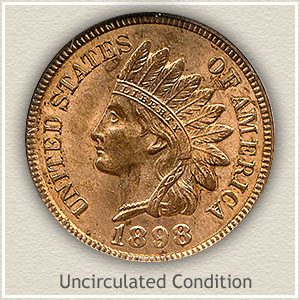
| Type | Variety 3 - Bronze |
| Designer | James B. Longacre |
| Years Minted | 1864-1909 |
| Weight | 3.11 grams |
| Composition | 95% copper, 5% tin and zinc |
| Diameter | approx. 19 mm |
| Edge | plain |
| Mints | Philadelphia - no mint mark San Francisco - S |
| Mintage | PhiladelphiaSan Francisco - S 1864 - 39,233,714 1908S - 1,115,000 1865 - 35,429,286 1909S - 309,000 1866 - 9,826,500 1867 - 9,821,000 1868 - 10,266,500 1869 - 6,420,000 1870 - 5,275,000 1871 - 3,929,500 1872 - 4,042,000 1873 - 11,676,500 1874 - 14,187,500 1875 - 13,528,000 1876 - 7,944,000 1877 - 852,500 1878 - 5,797,500 1879 - 16,228,000 1880 - 38,961,000 1881 - 39,208,000 1882 - 38,578,000 1883 - 45,591,500 1884 - 23,257,800 1885 - 11,761,594 1886 - 17,650,000 1887 - 45,223,523 1888 - 37,489,832 1889 - 48,866,025 1890 - 57,180,114 1891 - 47,070,000 1892 - 37,647,087 1893 - 46,640,000 1894 - 16,749,500 1895 - 38,341,574 1896 - 39,055,431 1897 - 50,464,392 1898 - 48,821,284 1899 - 53,598,000 1900 - 66,831,502 1901 - 79,609,158 1902 - 87,374,704 1903 - 85,092,703 1904 - 61,326,198 1905 - 80,717,011 1906 - 96,020,530 1907 - 108,137,143 1908 - 32,326,367 1909 - 14,368,470 |
Return From Indian Head Penny to US Coins
See Where the Mint Mark is located on US CoinsIndian Head Cent
Longacre substitutes Indian Head designs for Flying Eagle By Paul Gilkes
COIN WORLD Staff Difficulty in modifying the Flying Eagle cent design to correct the problem of short die life and poor strikeability led Chief En...READ MORE
Indian Head Cent
Longacre substitutes Indian Head designs for Flying Eagle By Paul GilkesCOIN WORLD Staff Difficulty in modifying the Flying Eagle cent design to correct the problem of short die life and poor strikeability led Chief Engraver James Barton Longacre to abandon the eagle motif in favor of his new Indian Head design in 1859. The head and tail of the eagle on the obverse of the copper-nickel Flying Eagle cent were positioned directly opposite the wreath on the reverse, creating weakness in the detail of the design with every strike. The chief engraver had been in his position for more than a dozen years when he was given the assignment to fix the existing cent design or produce a new one. At the same time Longacre produced the Indian Head obverse, three new reverse designs were also tested. One alternative included a plain oak wreath. The second choice depicted an oak wreath with a wide ornamented shield above. A third selection offered two versions of a plain laurel wreath. One of the latter two variations – the centered laurel wreath with low relief – was paired with the obverse Indian Head design to strike the first coins for circulation in 1859. The hub style was changed from narrow bust point in 1860 to a broad bust point, possibly to increase die life. A new reverse was introduced in 1860 as well, depicting a shield between the points of a new, oak wreath. A year before the Civil War ended, Congress took action to alter the composition of the small cents since the nickel coinage metal was in short supply and it was costing the Mint more than the face value to produce the coins. The Mint Act of April 22, 1864, amended the Act of Feb. 21, 1857, by changing the composition of the small cent from the 88 percent copper, 12 percent nickel – established with the Flying Eagle cent and the first nearly six years of Indian Head cent production – to a bronze alloy of 95 percent copper, 5 percent tin and zinc. This bronze alloy would remain constant throughout the rest of the Indian Head cent series, which closed its run in 1909. Along with the 2-cent coin, the bronze Indian Head cents marked the first token coinage of the United States, being valued only by the government stamp, not the metal content. The bronze Indian Head cent was released in July 1864. Its production proved profitable to the federal government, as 3.7 bronze cents could be reproduced from every recoined copper large cent. During the Civil War, large numbers of cents were hoarded, then later dumped into circulation, causing a glut. In 1871, this coinage saturation was alleviated when legislation called for the redemption and recoinage of all earlier minor coins, allowing financial institutions to redeem larger amounts of coins. Enough copper was redeemed to keep the Mint going for six years. In 1873, the country's economic woes plunged the nation's populace to again flood commerce with hoard coins as they could no longer afford to accumulate them. The new infusion of coins created rarities of the 1870, 1871 and 1872 dates, causing larger than usual mintages for the 1874 and 1875 cents. The Mint's self-imposed stance to combat high planchets prices by not buying them certain years resulted in lower production in 1885, 1886 and 1894. The Mint began making its own cent planchets in 1908. Indian Head cents were all struck at the Philadelphia Mint, except in 1908 and 1909, when examples were also struck at the San Francisco Mint. Mintage was low for the 1908-S issues since the San Francisco Mint, rocked by the Great Earthquake two years earlier, had only one press available to produce cents.
Indian Head cent | |
| Date of authorization: | Feb. 21, 1857 |
| Dates of issue: | 1859-1909 |
| Designer/Engraver: | James B. Longacre |
| Diameter: | 1859-1864: 19.30 mm/0.76 inch 1864-1909: 19.05 mm/0.75 inch |
| Weight: | 1859-1864: 4.67 grams/0.15 ounce 1864-1909: 3.11 grams/0.10 ounce |
| Metallic content: | 1859-1864: 88% copper, 12% nickel 1864-1909: 95% copper, 5% tin and zinc |
| Edge: | Plain |
| Mint mark: | 1908-1909, reverse under wreath |