The Flowing Hair, Small Eagle design was the first struck on silver coinage after the opening of First Philadelphia Mint in 1793. It was struck on half dimes, half dollars, and silver dollars, dated 1794 and 1795. The one and only 1794 dollar delivery was on October 15, 1794, and it can be presumed that the coins were struck earlier the same. Designed by Robert Scot, the 1794 Flowing Hair dollar is the coin that began the American tradition of silver dollars, even though it was, in concept, based on other large-size silver coins from other world governments.
- 1795 Flowing Hair Silver Dollar
Coin Info
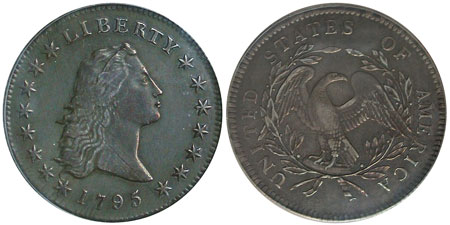
The 1795 Flowing Hair silver dollar represents the second year that dollar coins were officially produced in the United States. The year 1795 also represents a transitional period for the young silver dollars. In late 1795, the obverse of the silver dollar coin was changed from the Flowing Hair design to the Draped Bust design, for which the early American silver dollars would become much more widely known. This is especially true given the popularity of the rare, multi-million-dollar 1804 Draped Bust silver dollar.
The 1795 Flowing Hair silver dollar is a scarce coin in the absolute sense but far more common than its 1794 dollar counterpart. For this reason, type set collectors who desire a Flowing Hair dollar will tend to focus on buying a 1795 issue because it is the more affordable option in most cases. Even still, an entry-level 1795 Flowing Hair silver dollar in Good-4 without any signs of a cleaning, holes, or other damage or post-Mint problems will easily set a coin collector back by more than $2,000. Prices vary based on each coin’s individual condition, but damaged 1795 Flowing Hair dollars tend to trade for more than $1,000. Individuals looking for nicer pieces grading Fin-12 or better should plan on spending $4,500 or more.
A 1795 Flowing Hair silver dollar should be considered a scarce coin by any measure. Even through they were minted to the tune of 160,295 pieces, perhaps just 10,000 still survive, and most are in pretty bad shape.
Flowing Hair Silver Dollar Vs Morgan
Advanced collectors of early American dollar coins recognize several minor varieties that are usually identified in books and other media that specialize strictly in cataloging these rare silver dollars. However, 1795 Flowing Hair dollar coins are generally categorized into one of three types, and they include the 1795 Flowing Hair Two Leaves dollar, 1795 Flowing Hair Three Leaves dollar, and 1795 Flowing Hair Silver Plug dollar. The number of leaves refers to a design variant identified by counting the number of leaves beneath each wing of the heraldic eagle on the silver dollar’s reverse. Meanwhile, the silver plug measures 8 millimeters in diameter and was added by the United States Mint. It was inserted to minutely adjust the weight of the silver planchets, which were handmade back in the day.
Production of the Flowing Hair dollar continued throughout much of 1795, but the type was replaced by the Draped Bust design in October of that year. Like the Flowing Hair design, the Draped Bust dollar motif was designed by Robert Scot. Several denominations in the mid 1790s shared either or both the Flowing Hair and Draped Bust designs, including half cents, large cents, half dimes, dimes, quarters, and half dollars.
Other Years From This Coin Series
Latest Blog Posts
Latest Blog Posts
Draped Bust Dollar Overview
As one of the first coins ever produced by the newly-founded United States, the Draped Bust silver dollar is an elusive and valuable piece of history that is sure to be the pride of any collector lucky enough to own one.
The Draped Bust dollar was created in 1795 as a modification of and improvement upon the Flowing Hair dollar that had only been in production since the previous year.
The person responsible for the design of the Draped Bust dollar is not known for certain, although most accept Gilbert Stuart as the designer. The obverse design features a profile bust of Lady Liberty encircled by a ring of stars. At the top of the face is the legend “LIBERTY,” and at the bottom is the year of mintage.

There are two reverse designs for the Draped Bust dollar. The first was minted from 1795 to 1798 and is known as the Small Eagle design. It depicts a realistic eagle surrounded by a wreath with “UNITED STATES OF AMERICA” running along the rim.
The second reverse, minted from 1798 to 1804, is known as the Heraldic Eagle design because it swaps the realistic eagle for a more traditional heraldic variety. The legend remains the same, but above the eagle a spray of stars with a border of clouds was added.
Interestingly the denomination is found on the edge of the coin and is engraved as “HUNDRED CENTS ONE DOLLAR OR UNIT.”
Although the series officially ended with the 1804 mintage, a low number of sets were struck again towards the middle of the 19th century for diplomatic and numismatic purposes, and these pieces, still dated 1804, are some of the most famous and sought-after coins in American numismatics.
History of the 1799 Draped Bust Dollar

1799 saw the mintage of 423,000 Draped Bust silver dollars, a number that seems low to us now but was fairly high for the time, especially considering that dollar pieces were not all that common for everyday transactions. Indeed, 1799 is the largest mintage for the Draped Bust dollar.
Flowing Hair Silver Dollar Coin
In terms of design, the 1799 issue belongs to the Heraldic Eagle type, although both the obverse and reverse designs are subject to variation, as discussed in the next section.
From a compositional standpoint, this issue is typical for the series. It is between 89 and 90 percent silver and 10 to 11 percent copper. The diameter is 39 to 40 millimeters, and the mass is 27 grams.
Major 1799 Silver Dollar Varieties
Dies used for striking coins in this era were individually hand-carved, so it is not surprising that we find a wide range of varieties from this time period.
The 1799 silver dollar can be found in well over a dozen varieties, but there are seven major ones to keep a lookout for. They can divided into three groups based on the appearance of the mintage date: Normal Date, Irregular Date, and 9-over-8.
In Normal Date coins, the final “9” is in proper alignment with the rest of the date and the curve of the rim. There are three Normal Date varieties. The first is the 8 x 5 variety, meaning that on the obverse, there are 8 stars on the left side and 5 stars on the right side.
Flowing Hair Silver Dollar 1795 Value
The other two Normal Date varieties are 7 x 6, meaning the obverse has 7 stars on the left and 6 stars on the right. One 7 x 6 variety has berries on the olive branch on the reverse, and the other 7 x 6 variety displays no berries.
On Irregular Date coins, the final “9” is on the same plane as the previous “9,” which creates an odd look in relation to the rim. There are two Irregular Date varieties. The first features 13 stars, representing the 13 colonies, on the reverse.
The second variety has 15 stars, an error which was corrected by covering two stars with the clouds on the left and right edge of the design, though the stars are still slightly visible.
Finally, the 9-over-8 type is an overdate issue where the final “9” was punched over an “8” that can still be seen. As with the Irregular Date varieties, there is a variety that features 13 stars on the reverse and one which features the extra two covered up by clouds.
Valuing the 1799 Draped Bust Dollar
Due primarily to their age, 1799 Draped Bust dollars, like other specimens of the series, are very valuable, even in poor condition.
Flowing Hair Silver Dollar 1795
Although mostly minor, the different varieties can bring some significant variations in value. For simplicity’s sake, see the table below for a layout of the values of each variety.
Flowing Hair Silver Dollar Price
| G-4 | VG-8 | F-12 | VF-20 | XF-40 | AU-50 | MS-60 | MS-65 | |
| 9-over-8: 13 stars | $977 | $1,253 | $1,738 | $2,781 | $4,677 | $8,731 | $22,538 | $210,000 |
| 9-over-8: 15 stars | $989 | $1,379 | $1,788 | $2,882 | $5,274 | $8,894 | $23,101 | — |
| Irregular Date: 13 stars | $977 | $1,145 | $1,593 | $2,610 | $4,677 | $8,731 | $22,243 | — |
| Irregular Date: 15 stars | $977 | $1,145 | $1,593 | $2,610 | $4,677 | $8,731 | $23,101 | — |
| Normal Date: 7×6 – no berries | $977 | $1,145 | $1,593 | $2,610 | $4,677 | $8,731 | $22,243 | — |
| Normal Date: 7×6 – with berries | $928 | $1,145 | $1,593 | $2,610 | $4,677 | $8,731 | $22,538 | $497,587 |
| Normal Date: 8×5 | $928 | $1,145 | $1,593 | $2,610 | $4,677 | $8,731 | $22,538 | $497,587 |
Sources for values: https://www.usacoinbook.com/coins/dollars/draped-bust/
Flowing Hair Silver Copper Dollar
http://www.pcgscoinfacts.com/Coin/Detail/6884